Chat with our team
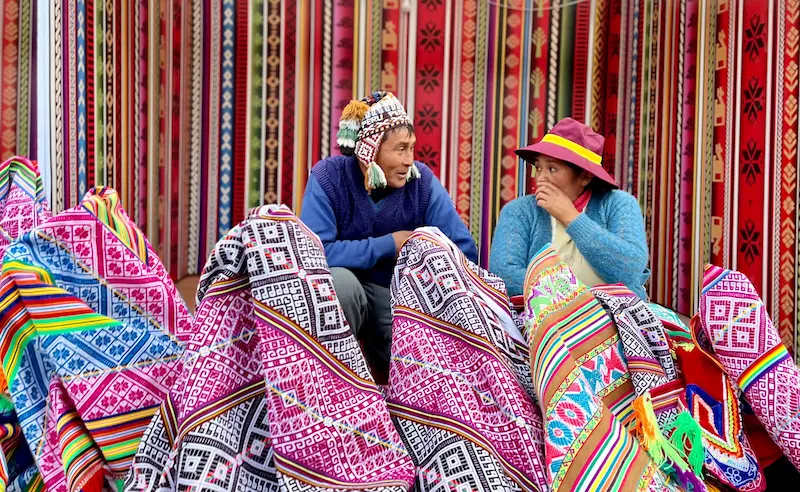
Andean textiles are fabrics and fiber-based creations made by the diverse cultures of the Andes, using techniques such as weaving, knitting, embroidery and braiding. In Peru, their history extends far beyond the Inca Empire, while their contemporary forms remain part of community life. Understanding them means looking at materials, construction, purpose and the people who make them.
For travelers, these textiles offer a way to explore Peru through details that are easy to overlook: the arrangement of threads, the finishing of an edge or the explanation of a locally recognized pattern. This article introduces their history, production and cultural importance, with examples that show why no single garment or design can represent every Andean community.
The expression “Andean textiles” describes a broad field rather than one uniform style. It encompasses objects from different periods and places, including archaeological garments, colonial fabrics and pieces made by living artists. Although this article focuses on Peru, the Andes extend across several countries, and their textile histories cross modern national boundaries.
A useful starting point is to ask three questions about any piece: who made it, where it comes from and what it was intended to do. Those details help distinguish a ceremonial garment from an everyday carrying cloth, or a historical object from a contemporary interpretation.
Textile production in Peru developed long before Inca rule. Archaeological collections preserve work associated with cultures such as Paracas, Nasca, Wari and Chimú, demonstrating that sophisticated fiber arts were already established across different regions.
Paracas textiles provide a particularly striking example. The Metropolitan Museum of Art’s collections include embroidered pieces combining cotton and camelid fiber, while its exhibition research describes elaborate garments with colorful imagery. These objects challenge the assumption that ancient textiles were simple or merely practical.
When viewing these pieces, look beyond their age. Notice how figures repeat, how borders organize a surface and how embroidery relates to the underlying fabric. Such observations make it easier to appreciate the decisions involved without inventing a meaning for every shape.
It is equally important to keep cultural names distinct. A Paracas embroidered fragment and a Wari tunic should not automatically be labeled “Inca.” Accurate identification makes the history more interesting because it reveals differences rather than compressing centuries into a single civilization.
Under Inca rule, cloth could communicate rank and political authority. The finest fabric, often called cumbi or qompi, was subject to controlled production and use. Garment materials and decoration therefore mattered beyond their visual appearance.
Some Inca tunics feature geometric compartments known as tocapu. These carefully organized designs formed part of a broader visual system associated with dress and status. Their presence should not be treated as permission to translate every individual motif into a confidently stated word or message.
For a museum visitor, the useful question is not simply whether a tunic looks beautiful. Ask how its construction, decoration and recorded context help researchers understand the person or institution associated with it.
This approach also changes how you see craftsmanship. Fine thread and precise construction were not incidental details added after a garment’s social importance had been established; they were part of how that importance became visible.
Andean textiles continued to develop after the Spanish conquest. Colonial examples combine Indigenous forms with introduced materials and imagery. Sheep’s wool, silk and metallic threads became part of a changing textile environment, while makers also produced objects for churches and private households.
Continuity therefore does not mean that everything remained unchanged. A tradition can retain knowledge while incorporating different fibers, tools, markets or aesthetic choices.
The Centro de Textiles Tradicionales del Cusco, or CTTC, describes its work in terms of recovering and revitalizing techniques, designs and natural dye practices. Its history highlights the contribution of weavers who actively researched and renewed knowledge rather than simply repeating an uninterrupted process.
For travelers, this distinction matters. A contemporary artist does not become less worthy of attention because they experiment or create for sale. Ask what connects a piece to local practice and what the maker has chosen to change.
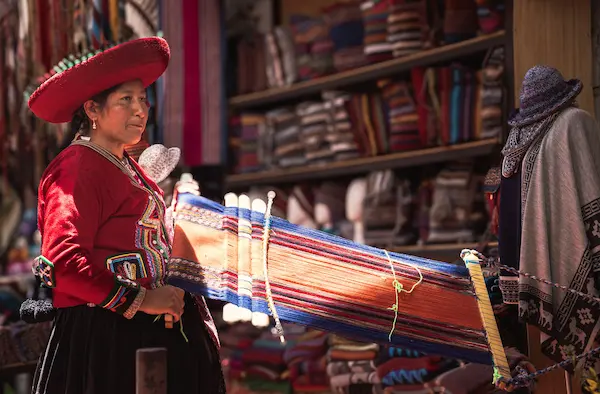
A finished textile reveals only part of the work involved. Fiber selection, yarn preparation, dyeing, arranging the threads and finishing the edges all deserve attention. Looking at these stages separately helps explain why two objects of similar size may involve very different amounts of labor.
Andean textiles also encompass several construction methods. A knitted hat, an embroidered cloth and a woven belt may share a regional context, but they are not made in the same way. Learning a few basic distinctions makes demonstrations and museum labels much easier to follow.
Cotton and camelid fibers appear throughout historical Andean textile collections. Camelids include alpacas and llamas, as well as vicuñas and guanacos. Their fibers should not be treated as interchangeable, and a museum description may identify only “camelid fiber” when a more specific attribution is unavailable.
Sheep’s wool is also part of contemporary highland textile production. In Accha Alta, for example, CTTC documents the use of sheep, alpaca and llama fibers, which may be naturally dyed or left in their original colors.
When shopping, separate the fiber question from the production question. “Alpaca” describes a material claim; it does not establish whether a garment was handwoven, machine-knitted or made locally.
The following distinctions can help organize a conversation with a maker or seller:
| Detail | What to ask | What the answer helps clarify |
| Fiber composition | What fibers does this piece contain? | Whether it uses one material or a blend |
| Yarn preparation | Was the yarn handspun or commercially produced? | One stage of the production process |
| Color | Is the fiber undyed, naturally dyed or synthetically dyed? | How its appearance was achieved |
| Construction | Was it woven, knitted or embroidered? | The technique used to form or decorate it |
| Provenance | Who made it, and in which community? | Its connection to a particular maker or place |
| Care | How should it be cleaned and stored? | Whether it suits your intended use |
Neither softness nor price alone answers all these questions. A detailed explanation is more useful than a broad label such as “traditional” or “premium.”
Spinning introduces twist into prepared fibers to create yarn. At CTTC’s “Weaving Lives” museum, interpretation includes the use of a pushka, or drop spindle, and the preparation of yarn for a backstrap loom. The exhibition also introduces plants, minerals and animal-derived materials used in dyeing.
During a demonstration, watch how the maker controls the yarn rather than focusing only on the finished skein. Ask which stage you are seeing and what still needs to happen before weaving can begin.
Natural dye practices are particularly well documented in Chinchero. CTTC describes the renewed use of indigo, cochineal and chilka in local weaving, following efforts to recover dyeing knowledge.
However, color is not reliable proof of a dye’s origin. A muted palette does not automatically mean natural dyes, and a bright textile is not automatically synthetic. Ask about the specific piece instead of judging solely by appearance.
Avoid expecting a short demonstration to represent the full production time. Preparing ingredients, processing fibers and obtaining a consistent result may involve work that happened before visitors arrived.
A backstrap loom uses tension between a fixed support and a strap worn by the weaver. The maker adjusts that tension through body position while working with the threads. CTTC’s descriptions emphasize how relatively simple tools can support highly sophisticated weaving.
Two useful terms are warp and weft. The warp is the set of threads arranged on the loom; the weft passes across them. A demonstration becomes easier to understand when you can identify these two directions.
In Chinchero, CTTC documents complementary warp-faced weaving, including textiles designed to be used on both sides. This is a specific technical tradition, not a description that applies automatically to every cloth sold in the region.
Knitting follows a different process, forming fabric through connected loops. Embroidery adds stitches to an existing fabric. Recognizing those differences prevents the common mistake of calling every patterned object “woven.”
Ask permission before touching a loom or unfinished work. Moving a tool or pulling a thread can interfere with a process whose organization may not be obvious to an observer.
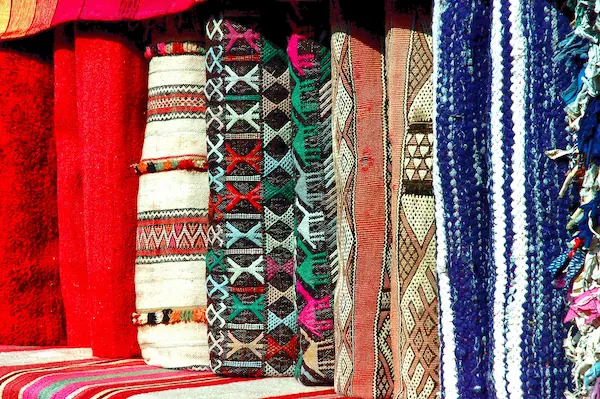
Patterns attract attention first, but their interpretation requires context. A design may have a locally recognized name, a relationship to a familiar object or a particular place within a garment. None of that establishes a universal visual dictionary for the entire Andes.
When learning about Andean textiles, distinguish between a maker’s explanation, a documented scholarly interpretation and your own visual impression. All can contribute to appreciation, but they should not be presented as the same kind of evidence.
CTTC’s publication on Chinchero documents motifs associated with plants, animals, geographical features and agricultural tools. This provides a grounded way to discuss connections between textile design and the surrounding environment.
Rather than asking only “What does this symbol mean?”, try asking “What is this pattern called here?” or “How did you learn to make it?” These questions allow the weaver to explain the design within their own experience.
Historical interpretation also has limits. The Metropolitan Museum’s Andean tunic research notes, for example, that the precise significance of pelican imagery in certain Chimú textiles is unknown. An identifiable animal does not necessarily come with a fully established symbolic translation.
Be cautious with claims that every diamond represents the same concept or every color carries one fixed meaning. If an explanation lacks a named community, object or source, treat it as a starting point for questions rather than a settled fact.
Clothing can be understood more clearly when examined as a complete ensemble. The relationship between a hat, belt, shawl and other garments may matter as much as an isolated motif.
Taquile offers a documented example. UNESCO describes textile art as a daily activity shared across generations and identifies garments such as the knitted chullo and woven calendar waistband within the island’s tradition. Its account connects textile production with community life rather than presenting it only as a visitor attraction.
For travelers, the respectful approach is to ask before drawing conclusions about someone’s age, marital status or social role from their clothing. Information about one community should not be transferred automatically to another.
The same care applies to photography. Ask before taking a close portrait, especially when your interest is a person’s clothing. A conversation can provide context that a photograph alone cannot capture.
Andean textiles are not limited to display pieces or special celebrations. CTTC’s documentation of Accha Alta includes woven sacks made from alpaca and llama fiber for transporting agricultural produce, as well as knitted hats worn in daily life.
This example helps broaden what travelers consider worth noticing. A practical object may reveal technical knowledge just as clearly as an elaborately decorated garment.
Historical textiles also served ceremonial and funerary purposes, as shown by archaeological examples and their recorded contexts. However, the function of a particular piece should be established through evidence rather than assumed from its elaborate appearance.
When a guide describes a textile as ceremonial, ask what that means in the specific case. Is it worn for a named occasion, used by a particular person or associated with an archaeological setting? A precise explanation is more informative than a general reference to “ancient rituals.”
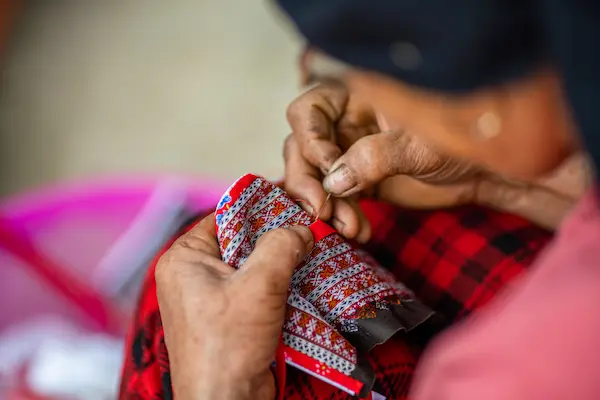
Community interpretation, museums and conversations with makers offer different ways to learn. None replaces the others: a museum can provide historical comparison, while a working textile center can explain decisions involved in producing a contemporary piece.
As you explore Peru travel destinations, consider textile learning as a cultural focus rather than an additional shopping stop. Leave enough time to observe, ask questions and understand what is being presented.
Chinchero is an important example for travelers interested in textile production. CTTC documents the work of the Away Riqcharicheq association and its role in recovering designs and dyeing practices. Its educational activities include demonstrations of different stages of textile making.
Before arranging a visit, ask who leads the explanation and whether the session focuses on dyeing, spinning, weaving or several stages. Also confirm the language, duration and any participation fee.
Other communities provide different perspectives. CTTC’s account of Mahuaypampa describes an association formed in 2000 that worked with older weavers to recover and pass on local traditions. This is a useful reminder that cultural transmission often involves deliberate organization and teaching.
Avoid expecting every community to present the same demonstration or sell the same objects. Differences are part of what makes learning about regional textile practices worthwhile.
If you have a particular interest, such as spinning or finishing techniques, communicate it beforehand. A focused question helps the organizer explain whether the proposed visit matches what you want to learn.
UNESCO inscribed Taquile and its textile art on the Representative List of the Intangible Cultural Heritage of Humanity in 2008, following its earlier proclamation in 2005. The recognition concerns knowledge and practice within the community, not a certification attached to every individual product.
Visitors considering tours in Puno can ask whether a proposed itinerary includes Taquile and what opportunity it provides to learn about its textile tradition. Confirm the actual program instead of assuming that every Lake Titicaca visit includes the island.
UNESCO’s description emphasizes participation by men and women of different ages. That makes Taquile a valuable example of why generalized statements such as “Andean weaving is exclusively women’s work” are misleading.
During a visit, listen for distinctions between knitting and weaving, and ask about the specific object being shown. A short explanation of one garment can be more informative than trying to understand an entire tradition at once.
Museums offer a way to compare Andean textiles across periods without treating them as one continuous visual style. Begin with the label: culture, approximate date, materials, technique and provenance each answer a different question.
Try a simple observation exercise:
This method makes a museum visit more active without requiring specialist knowledge. It also discourages the temptation to decide that two objects share a meaning simply because they share a shape.
For contemporary interpretation in Cusco, CTTC’s “Weaving Lives” museum introduces stages of production and regional textile knowledge. Check visitor arrangements directly before building your schedule around a particular exhibition or activity.
Respect photography and handling rules. Textiles are best appreciated without touching unless staff or the maker explicitly invite you to do so.
Buying Andean textiles becomes a more informed decision when you understand what is being offered. Start with provenance and construction, then consider whether the piece suits the way you intend to use it.
Useful questions include:
Ask whether information can be included on a label or receipt, particularly for a more expensive purchase. A written record preserves details that are easy to forget after visiting several shops.
Do not rely on a single shortcut to establish authenticity. A slight irregularity does not prove hand production, and a polished finish does not disprove it. Likewise, a low price cannot explain the maker’s circumstances or establish the fiber composition.
Choose according to clear information and your priorities. You might value a locally made contemporary design, a handspun and handwoven cloth or a practical garment with an accurately described blend. These are different purchases, and transparency helps you distinguish them.
The future of Andean textiles depends on people having opportunities to learn, practice and develop their skills. CTTC’s work includes community organization, workshops and educational projects, demonstrating that safeguarding textile knowledge involves sustained activity rather than admiration alone.
As a traveler, you can begin by giving that work your attention. Allow makers to explain their choices, ask specific questions and avoid expecting every object to illustrate a simplified story about the past.
A meaningful encounter may start with something small: understanding how an edge is finished, learning the local name of a pattern or recognizing the difference between woven structure and embroidered decoration. Those details make the craft more tangible.
Andean textiles offer a way to see Peru through both historical objects and contemporary creativity. Their value becomes clearer when you look beyond a colorful surface and consider the knowledge, labor and individual decisions behind each piece.
Leave a comment